|
Richard Bonython and Lucretia Leigh and Family Documents
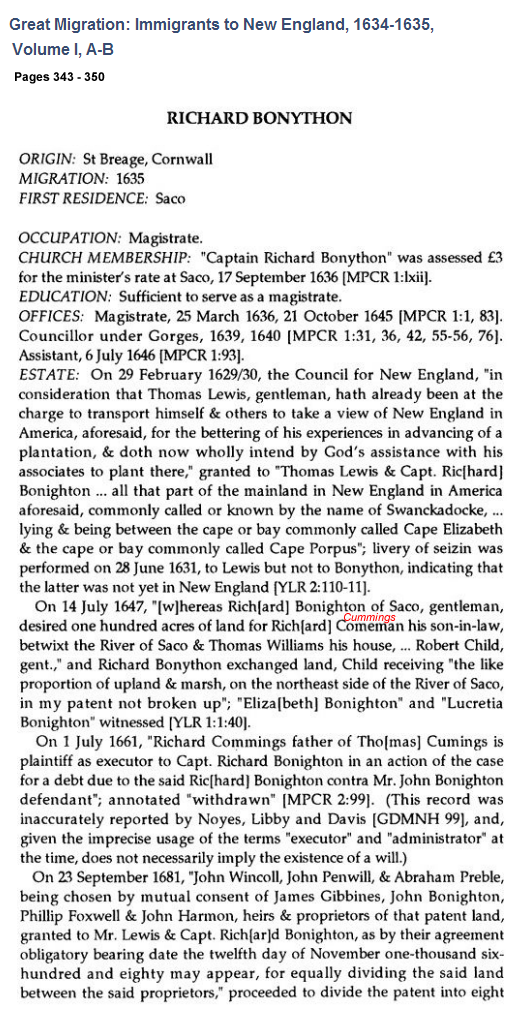
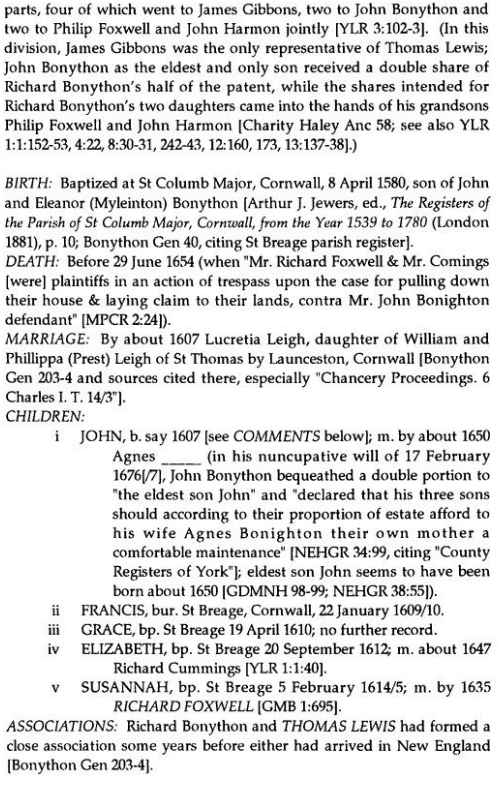
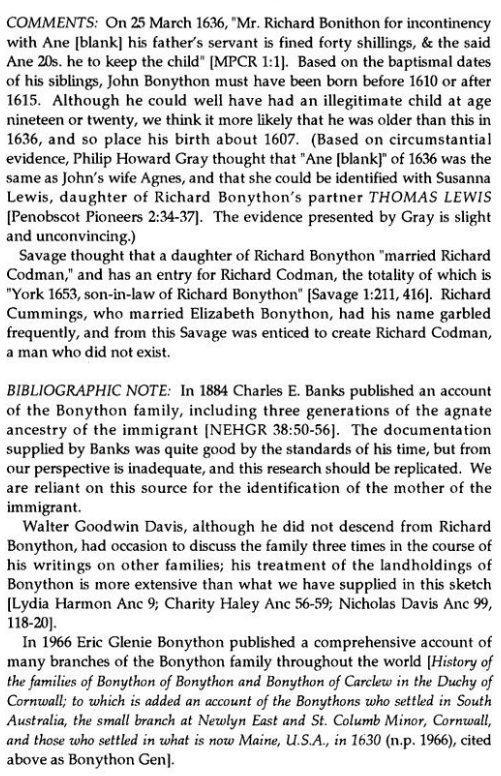
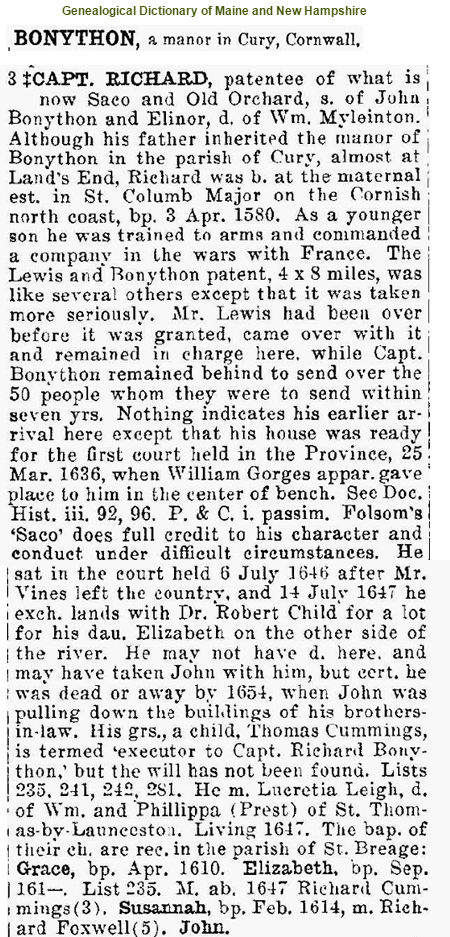
The account by Charles E. Banks of the Bonython family appears below. I'm guessing by his surname that he is a descendant of Elizabeth Bonython Cummings. Of interest to our family is that the address he uses on some of his publications is the U.S. Marine Hospital, Chelsea, Massachusetts. When we lived there it was known as the U.S. Naval Hospital, Chelsea. Our quarters were built during the Civil War. Wouldn't be interesting to know if by some chance Dr. Banks and his family lived in the same house?
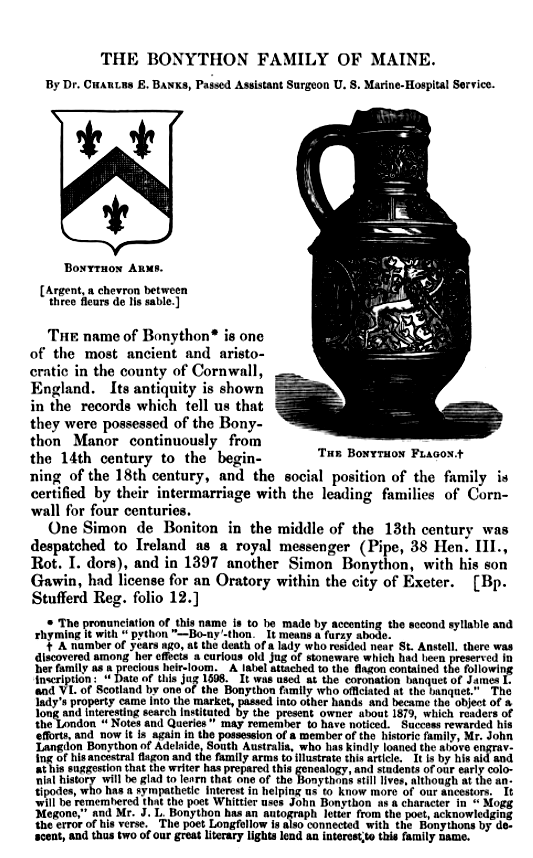
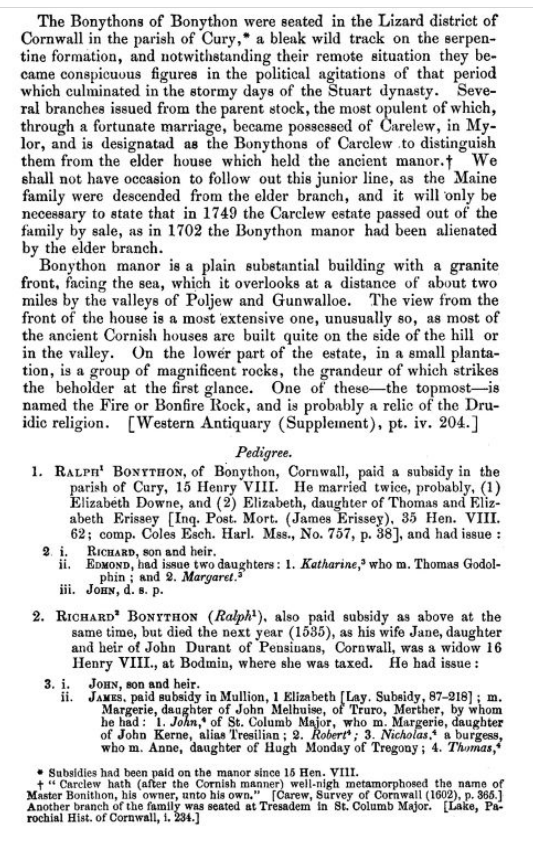
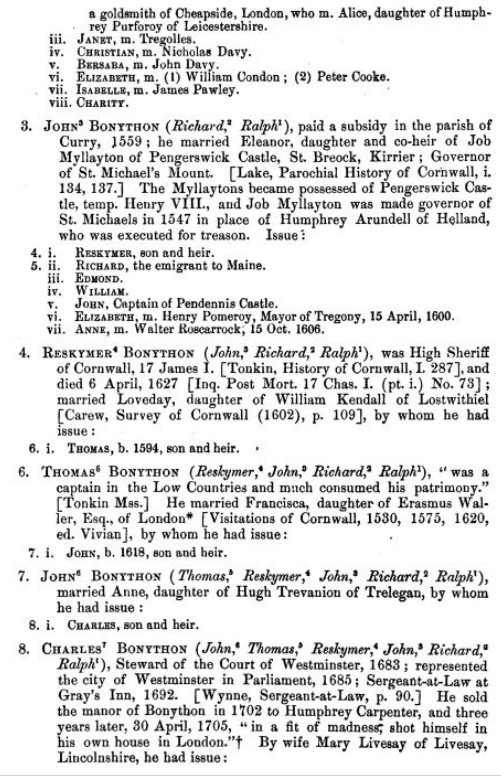
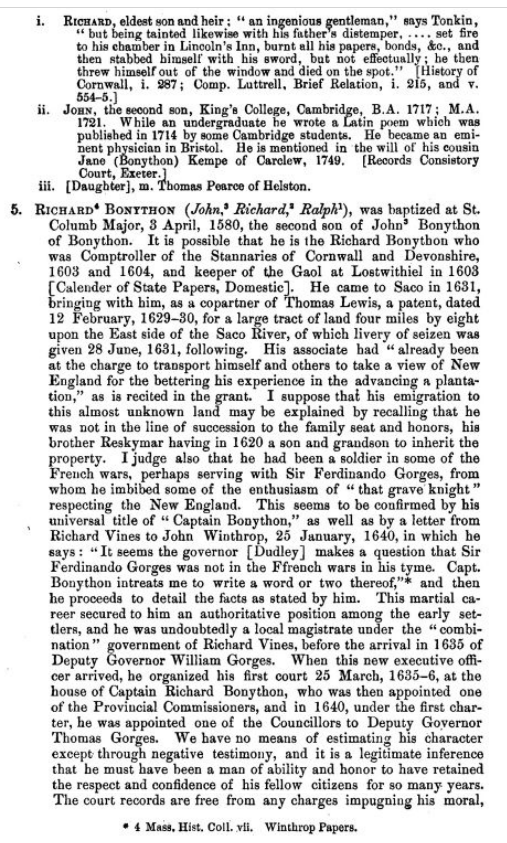
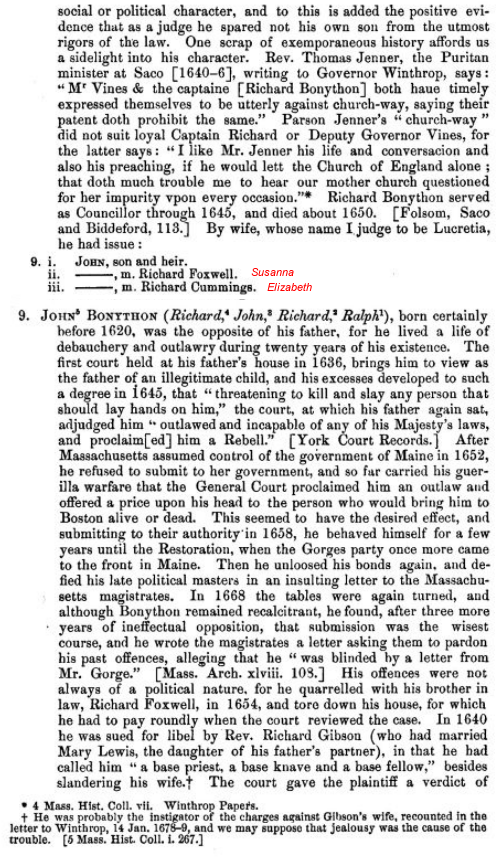
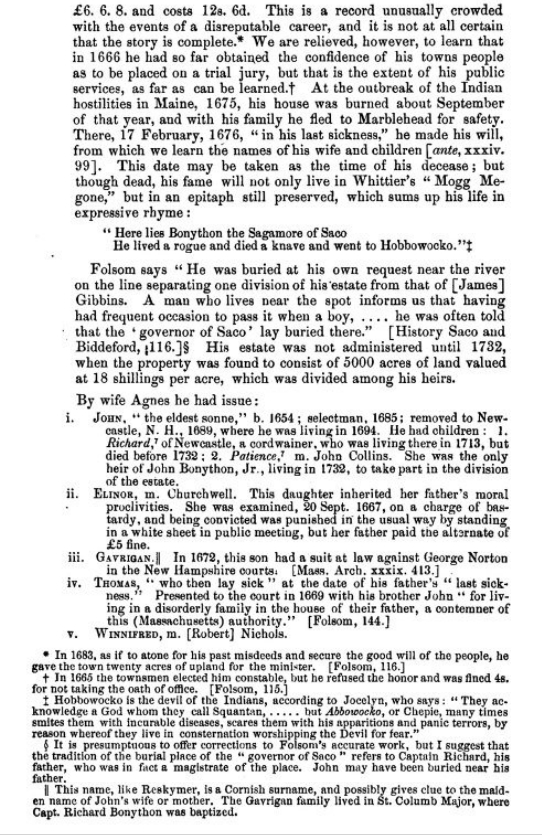
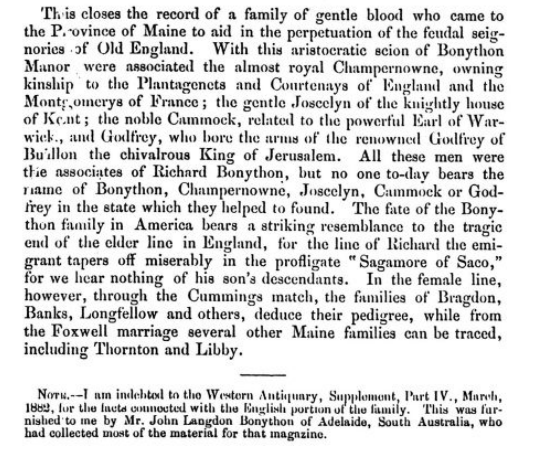
The article below provides excellent information about the name as well as the family.
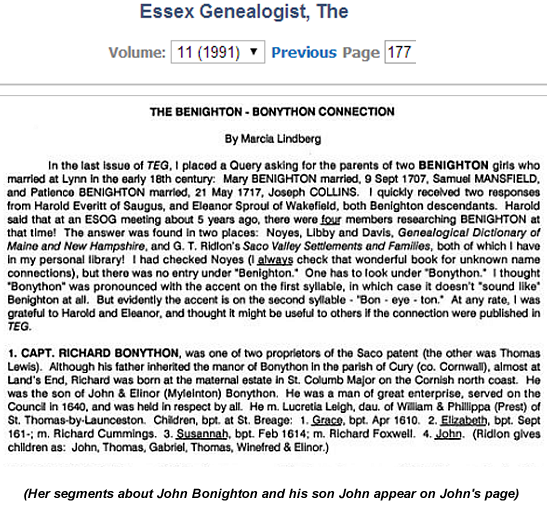
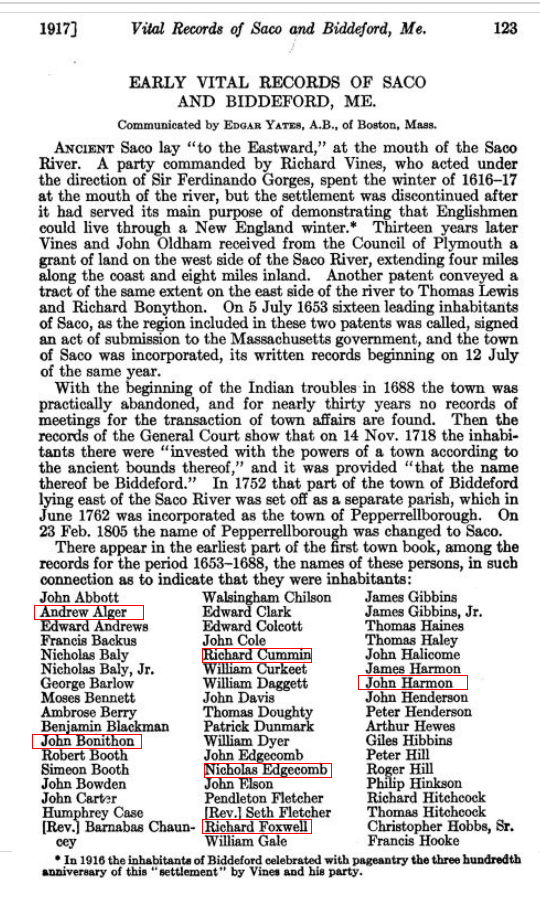
The Bonythons of the first few generations married with the families of other settlers in Maine even though the Indian wars resulted in many of them settling at least temporarily in the Marblehead/Lynn/ Salem area of Massachusetts. After working with the names of the families, I was struck by how many of the families became part of the Bonythons. Their names are circled in the article. John Ashton (not listed) married Susanna Foxwell, daughter of Susanna Bonython and Richard Foxwell; his first wife was a daughter of an Alger and his third wife, who was by then also in Marblehead was a widow, Mary Edgecomb Page. Elizabeth Cummings, daughter of Elizabeth Bonython and Richard Cummings, married John Harmon.
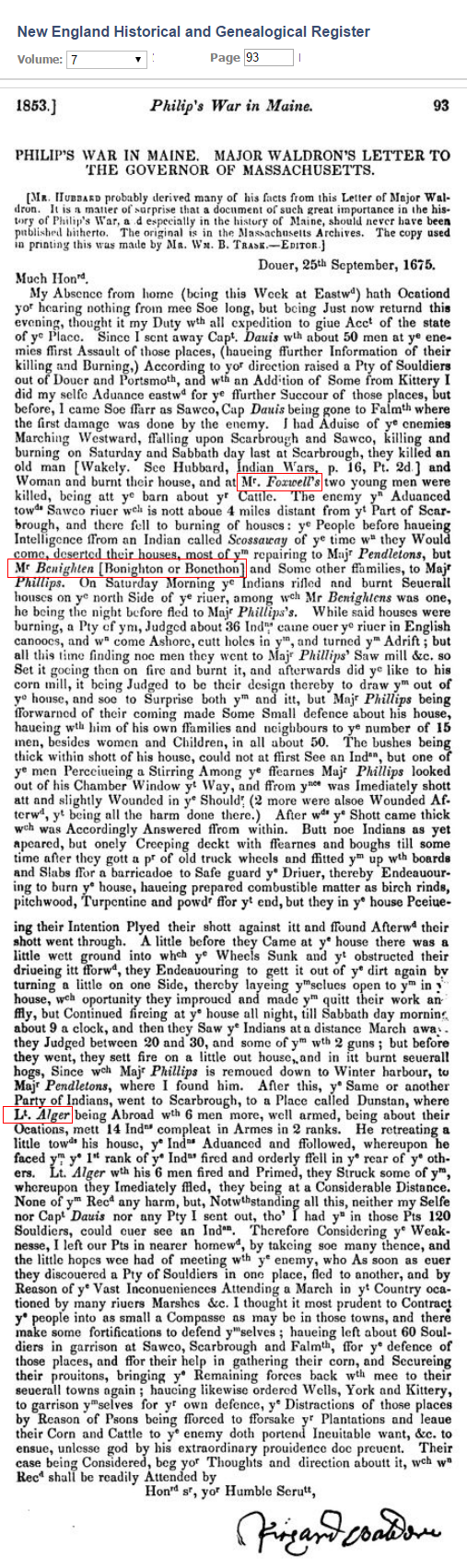
In the passages below we see reference to the Bonythons including one of John's sons in law, Thomas Rogers as well as a glimpse into the Indian wars that caused many of the family to move to the Marblehead area.
EXCERPTS from History of Saco, Maine
From
A Gazetteer of the
State of Maine by Geo. J. Varney,
Published by B. B. Russell, 57 Cornhill, Boston 1886,
Transcribed by Betsey S. Webber
Saco, in York County, was granted in 1630, to Thomas Lewis
and Richard Bonython, by the Plymouth Company, though the latter
had, in 1622, granted nearly the whole territory between this and the
Kennebec River, to Mason and Gorges. The tract granted to Lewis
and Bonython, extended four miles along the sea in a straight line,
and back into the country eight miles. The limits, as surveyed by the
commissioners appointed by Massachusetts, in 1659, commenced at the
mouth of Little River and run on a north-west line, leaving about 3,000 acres in Scarborough that belonged to the original patent. This grant was also over-lapped by the “Plough Patent,” issued the same year.
The settlement on this grant with that on the other side of the river
was known as Winter Harbor. In 1653, it was organized as Saco, and
in 1659, began to be represented in General Court. In 1719, it was incorporated as Biddeford, being the fourth town in Maine; in 1762 it received a separate incorporation, with all the rights of a town ex
cept that of sending a representative to the General Assembly. This
incorporation was under the name of Pepperellborough, in honor of
Sir William Pepperell, then recently deceased, who had been a large
proprietor. In 1805, by act of Legislature, its name was changed to
Saco; and in 1867 it became a city. The first mayor was Joseph Hobson. The name, Saco, is of Indian origin. The river separates
the city from Biddeford on the south-west, Scarborough bounds it on
the north-east, on the west and north-west is Buxton, and Old Orchard
Beach forms its junction with the sea on the east. The area is about 17,500 acres. For many years the habitations were located near the sea, at Old Orchard Beach and toward the mouth of the river. Rich-
ard Vines was the founder of the settlements in this vicinity, having
himself wintered at the mouth of the river, in 1616-17. Among the early inhabitants were Scammans, Edgecombs, Townsends, Youngs, Sharps, Banks, Sands, and Googins. There were a considerable num
ber of respectable Scotch immigrants from the northern part of Ire-
land, who came over about 1718, and after. Captain Scamman and
persons employed at the mill, with their families, were all that were settled about the falls until 1731. In 1680, Benjamin Blackman purchased 100 acres of land including the mill privileges on the east side of the Saco Falls, and built a saw-mill.
During the year 1675, the first year of the first Indian war, Major
Phillips on the Biddeford side of the river was attacked, and successfully defended. About the same time, the house of John Bonython, in Saco, was burned, but the family had escaped. The settlers about the falls soon retired to near the mouth of the river, and all the mills
and houses above were destroyed by the Indians. Captain Wincoln,
and others of Piscataqua, coming soon after to aid their neighbors
of the Saco, were discovered by some of the Indians, and fired upon.
Informed of the approach of the English, about 150 savages rushed out
of the woods toward them, as they landed on the beach near Winter
Harbor. During the skirmish, Wincoln and his men found protection
behind a pile of shingle-bolts; and, with this advantage, they soon
drove their assailants from the ground, inflicting upon them a considerable loss. Eleven of the inhabitants of Winter Harbor set out to aid their friends, whose presence and danger had been announced by the firing; but a body of Indians lay in ambush on their road, and
shot them all down at a single discharge. In 1676, the house of
Thomas Rogers, near Goosefare, was burned. In 1688, during the
second war, some of the Indians on the river having uttered alarming threats, sixteen of those who had been most active in the recent
war, were seized and taken to Boston, but without averting the threat
ened war. In April 1689, the savages commenced hostilities, and the
family of Humphrey Scamman and others were carried into captivity.
Most of the men were absent from the fort when the alarm was given there, and the women immediately arrayed themselves in male apparel, and stalked about the fort, thus deceiving the skulking savages until
the men got in from their work. Again from 1702 to 1710, Indian
hostilities prevailed. About 1713, the inhabitants began to return to their homes; and the settlement prospered until 1723, when another Indian war broke out, lasting three years.
Richard Bonython, the pioneer and one of Gorges' councilors, is
notable as a faithful and just man, even entering a complaint against
his own son John for using threatening language to the excellent Mr. Vines. John bore a different character, being violent and quarrelsome. He seems not to have gained the confidence of the better or
larger portion of his townsmen; yet when Massachusetts extended her jurisdiction over Maine, he led the opposition gaining the sobriquet of “Sagamore of Saco.” The following couplet is said to have been inscribed upon his tombstone, probably not by his relatives:
“Here lies Bonython, Sagamore of Saco,
He lived a rogue, and died a knave and went to Hobbomocko”
Yet, he was not without his good traits. In opposing Massachusetts he was vindicating the rights of Gorges; and he generously presented the town with 20 acres of upland for the minister.
|
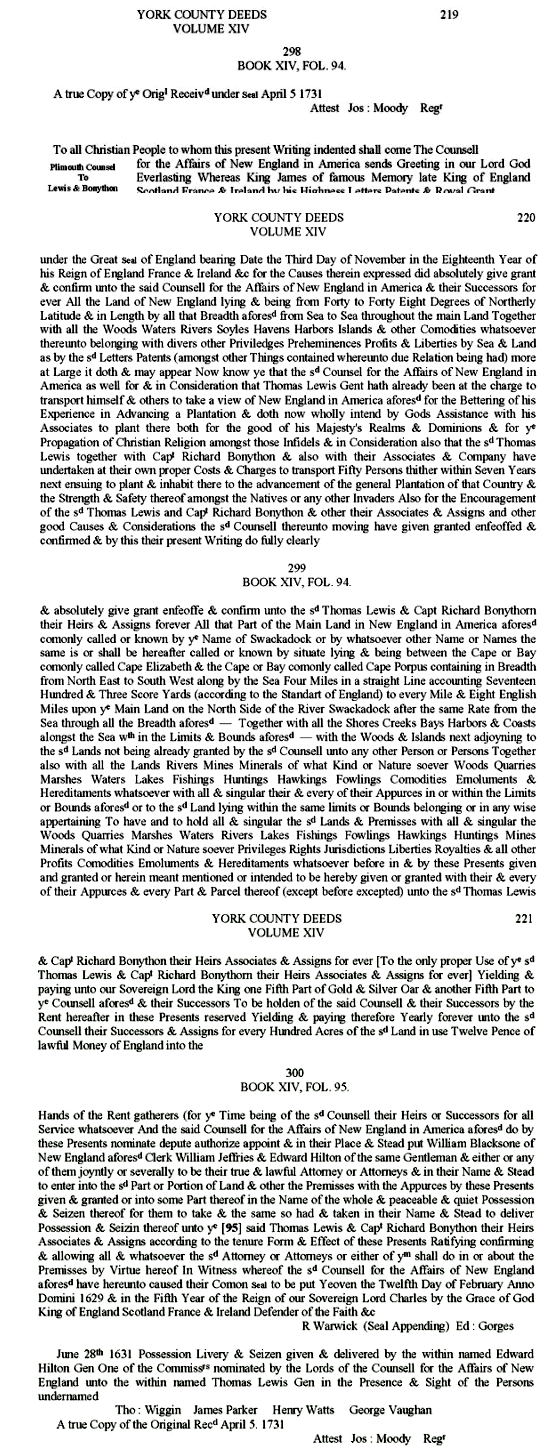
The letter below written by Major Waldron gives a first-hand account of the battles the second and third generations of the Bonythons faced in Maine.
A biography of Richard Bonython's partner Thomas Lewis offers some tidbits about Bonython as well.

|
